














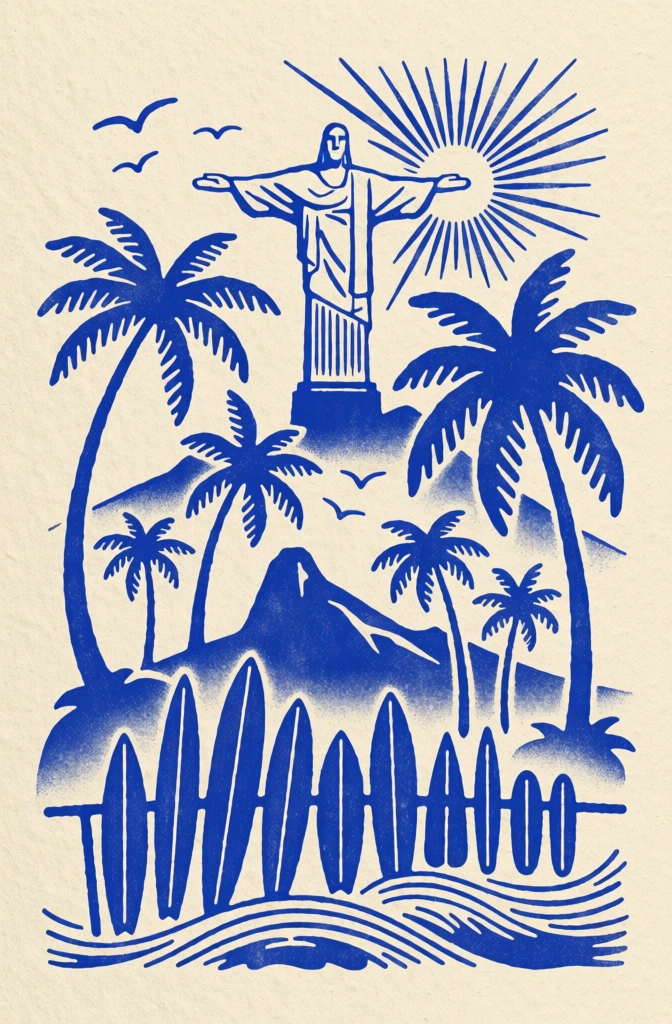
A clean, graphic blue-on-cream illustration shows a tropical Rio de Janeiro scene centered on the Christ the Redeemer statue, surrounded by palm trees, surfboards, ocean waves, birds, and a rising sun, all arranged inside an oval-like composition. Vector illustration, linocut-inspired stencil graphic, monoline and solid-fill shapes, travel poster iconography, tropical landscape emblem, minimalist decorative print, modern folk-art feel, retro tourism aesthetic, crisp edges, medium visual complexity, visually adjacent to Matisse paper-cut simplification, Saul Bass graphic reduction, vintage screenprint posters, cobalt blue and off-white palette, high contrast, flat color, even soft lighting, no visible camera effects beyond slight paper texture and mild perspective from photographing a printed or painted surface, calm, sunny, breezy, coastal, celebratory. At the top center stands Christ the Redeemer with arms stretched horizontally, rendered in simplified robes; the head is small and oval, the body vertical, and the pedestal drops down into the middle of the composition. To the upper left of the statue is the tallest palm tree, its trunk rising from mid-left and curving slightly upward, crowned with five large serrated fronds and a cluster of coconuts near the center. Above the statue on the upper right is a partial sun, mostly hidden behind the figure’s right arm, with long straight rays radiating upward and outward. Small bird silhouettes float around the sky: one just left of the statue’s torso, one near the upper right sky, one farther left near mid-height, and one near the lower right edge. On the right side, a large palm tree fills the upper-right middle, with another slimmer palm below it and a smaller one in the distant center-right. On the left middle, another palm tree spreads from the lower-left quadrant, while a shorter palm overlaps the pedestal area in the lower center. Behind the lower half of the statue, a dark mountain and hillside shape suggests Rio’s coastal terrain. In the bottom half, several surfboards lean diagonally from left and center: two tall boards on the far left, one narrow board near center, one broad board angled from center-right, and another large curved board to its right. Horizontal lines near their bases suggest a wooden rack or shoreline planks. The very bottom forms a rounded oval base filled with sweeping wave bands on the right and radiating shoreline or boardwalk lines on the left, anchoring the whole tropical badge-like composition against textured cream paper.
Beautiful AI-generated image on Krea. A clean, graphic blue-on-cream illustration shows a tropical Rio de Janeiro scene centered on the Christ the Redeemer statue, surrounded by palm trees, surfboards, ocean waves, birds, and a rising sun, all arranged inside an oval-like composition. Vector illustration, linocut-inspired stencil graphic, monoline and solid-fill shapes, travel poster iconography, tropical landscape emblem, minimalist decorative print, modern folk-art feel, retro tourism aesthetic, crisp edges, medium visual complexity, visually adjacent to Matisse paper-cut simplification, Saul Bass graphic reduction, vintage screenprint posters, cobalt blue and off-white palette, high contrast, flat color, even soft lighting, no visible camera effects beyond slight paper texture and mild perspective from photographing a printed or painted surface, calm, sunny, breezy, coastal, celebratory. At the top center stands Christ the Redeemer with arms stretched horizontally, rendered in simplified robes; the head is small and oval, the body vertical, and the pedestal drops down into the middle of the composition. To the upper left of the statue is the tallest palm tree, its trunk rising from mid-left and curving slightly upward, crowned with five large serrated fronds and a cluster of coconuts near the center. Above the statue on the upper right is a partial sun, mostly hidden behind the figure’s right arm, with long straight rays radiating upward and outward. Small bird silhouettes float around the sky: one just left of the statue’s torso, one near the upper right sky, one farther left near mid-height, and one near the lower right edge. On the right side, a large palm tree fills the upper-right middle, with another slimmer palm below it and a smaller one in the distant center-right. On the left middle, another palm tree spreads from the lower-left quadrant, while a shorter palm overlaps the pedestal area in the lower center. Behind the lower half of the statue, a dark mountain and hillside shape suggests Rio’s coastal terrain. In the bottom half, several surfboards lean diagonally from left and center: two tall boards on the far left, one narrow board near center, one broad board angled from center-right, and another large curved board to its right. Horizontal lines near their bases suggest a wooden rack or shoreline planks. The very bottom forms a rounded oval base filled with sweeping wave bands on the right and radiating shoreline or boardwalk lines on the left, anchoring the whole tropical badge-like composition against textured cream paper.
- Type
- Image
- Resolution
- 672 x 1024
- Published
- April 9, 2026
Prompt
Copy