 View full size
 Built for the big screen.
- 3
- Opening shots generated with AIThe opening of The Westies.
- 4K
- Made for high-resolution screensGenerated shots alongside principal photography.
Thanks to Cream Productions and Krea, AI and the camera end up in the same frame.
The production
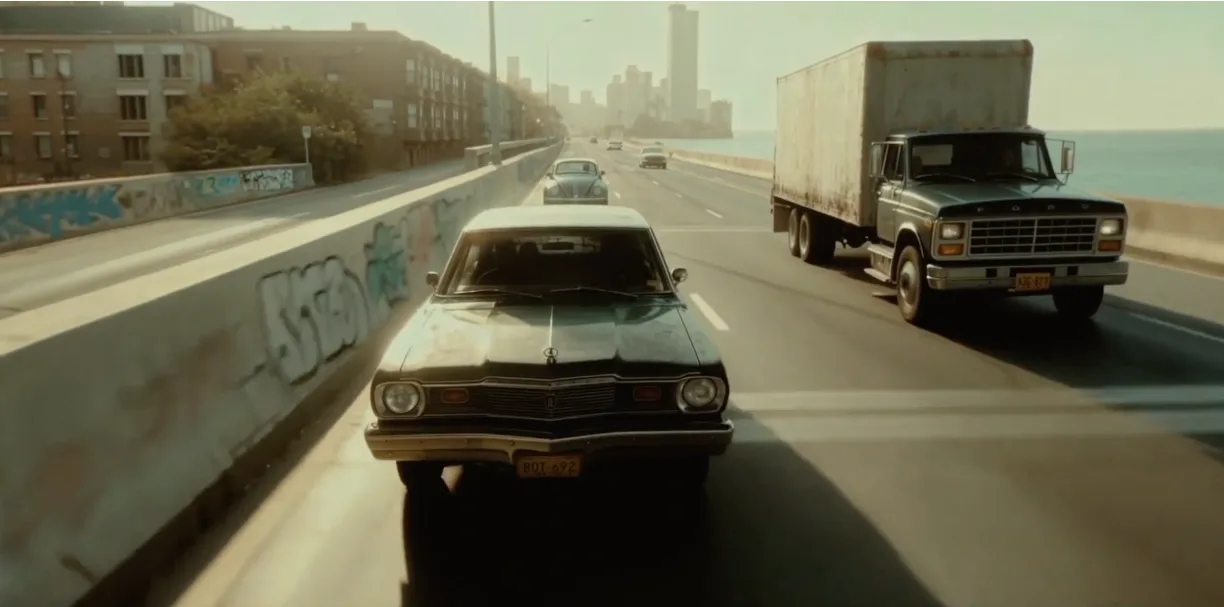
The first three shots of The Westies were not filmed. They had no camera, no set, no footage. Cream Productions generated them in AI, and they open a JK Simmons mob series on Amazon Prime, made for 4K, from Narcos creator Chris Brancato. The series is set in 1980s New York - period cars, wet streets, Times Square exactly like it looked back then - all of it built from nothing. It cuts in like it was shot on location, but it was done in Krea.
"The series needed to bring 1980s New York back to life. The producers came to us and said: Do you think this is possible? We said: lets give it a shot with AI."
Cream makes film and television the “traditional way”, but at the same time runs a really strong AI pipeline across close to ten series and a handful of films so far. The company in charge of that is Dark Half, wholly owned by Cream. The Westies is a good look at what Dark Half is doing with AI: in The Westies, AI isn’t standing in for the filmmaking, it’s part of it.
How they built it
Look closely at the first 40 seconds of The Westies and you’re really looking at three kinds of shot: the fully traditional, the fully AI and everything in between, where a single sequence is part camera and part model and you can’t always tell where the line falls. They sit inside the same shots, trading places. That intertwining is what makes The Westies special, and it’s a real hint at where AI in cinema is going.
Make no mistake: the majority of the series was shot the way traditional series get shot, with real actors and real cameras. The Times Square shot, however, was different. When pre-production began on Westies, the original plan was standard industry playbook: license raw, grainy 1980s stock footage to serve as period scene-setters.
Dark Half got involved when the producers decided to explore a more tailored approach, testing whether AI could generate those retro-style transitions to create bespoke storytelling beats. But as the first high-definition models dropped on Krea, the production team made a bold pivot: abandon the “grainy stock” look entirely and aim for photorealistic AI shots that could cut seamlessly alongside high-res principal photography.
Taking on seamless AI integration in the summer of 2025 was an exceptionally ambitious move. Models at the time couldn’t achieve total cinematic consistency alone, requiring Dark Half to pass the raw AI outputs through traditional VFX pipelines to manually fix a bunch of issues.
While today’s 2026 4k models handle those constraints automatically, the calculated risk taken by the Westies producers a year ago paid off delivering a custom-built 1980s New York that holds its ground right alongside live-action footage.
"The Times Square shot had so many elements that had to be historically accurate, and they didn't want to just use stock footage because it would stick out like a sore thumb. A New Yorker who lived in 1980 would look at it and go, ‘that's not what Times Square looked like’. The buildings had to be exactly where they actually were and it had to feel old and gritty."
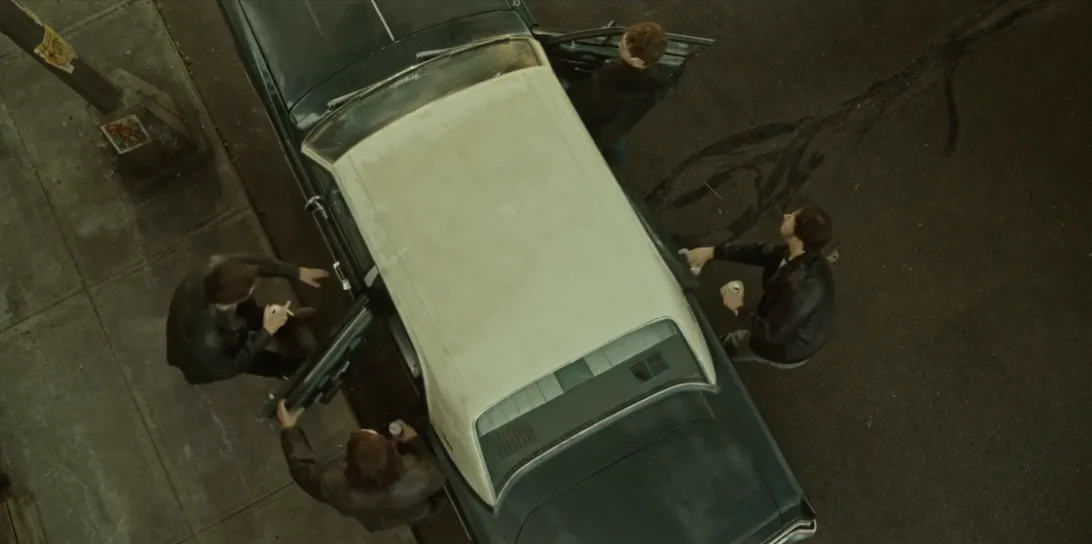
Take this departure sequence. The script required live actors getting into their picture car on the backlot, cutting directly to a shot of it cruising down the West Side Highway, a landmark that hasn’t existed since the 1980s.
Instead of building massive practical sets or relying on generic stock, Cream trained LoRAs on all the production’s rented vehicles (hero cars and ND traffic alike). They rebuilt 1980s Manhattan in AI and dropped their exact physical car onto the highway, surrounded by period-accurate vehicles. The practical shot and the AI generation lock together perfectly because they’re trained on the exact same steel.
But then this intertwining of AI and real footage got real funny, because it looped back the other way. Cream’s early pitch work helped shape the visual language for the physical sets. Over in the production office, they started noticing still frames from the 1980s NYC demo videos printed out, annotated, and pinned up across the art department’s inspiration walls. The production designers were using those AI concepts as a reference point for their physical builds, helping bridge the gap between initial look-dev and the sets built on the soundstage. AI helped set the direction, and physical production brought it home.
Take a step back and the line between AI and camera isn’t there anymore. Generated shots, filmed shots, and shots that are quietly both, all cut together into the same sequences without a seam. One of the best parts: they don’t work only in a feed or a demo. They hold up on big 4K screens, inside a high-end Amazon Prime series, where resolution, lighting, and continuity all have to be right.
"It's not like you're replacing actors. Both can coexist, and make each other better."
What it does to the budget
All of the above is great, but the first question out of any producer or exec is money: what does this save? On The Westies, the answer lands on both time and cost. [West East saving: figure to come from Cream] On some shots it wasn’t a cost question at all, they simply couldn’t have been made any other way. The comparison gets even starker on Cream’s other work:
- A two-minute trailer, roughly, made in Krea: about $15,000. The CGI quote to do the same thing came in at $300,000 to $400,000. Not only 20 times the price, but also months instead of weeks, and that’s if CGI could even reach the same quality. Today’s models are trained on huge volumes of real footage, so the messy natural stuff, storms, waves, landslides, land with a realism CGI still fights for.
"There's still an uncanny valley with some specific CGI, your brain says 'CGI.' A lot of these shots, CGI just couldn't get."
- An early trial network shot Dark Half handed over cost $329. The CGI house had bid $60,000 on it and still couldn’t quite nail it.
"They showed me a shot from AI that was brilliant, better than the CGI ever would have been. It cost $329, against $60,000. That's when the light bulb went on."
The bigger picture
The main takeaway from Cream’s success story is: AI didn’t pushed out the camera or the craft. AI turned into one more tool Cream reached for, as, for starters, it makes possible some shots that simply weren’t before. For seconders, it makes them cheaper and faster, and still solid on a 4K screen. Everyone’s been waiting for the point where AI and live film stop competing for the same job and just work together, and that’s exactly what Cream has done in The Westies.
Curious what Krea could do for your production?
Talk to our enterprise team about bringing Krea into your film or television workflow.
Contact Sales